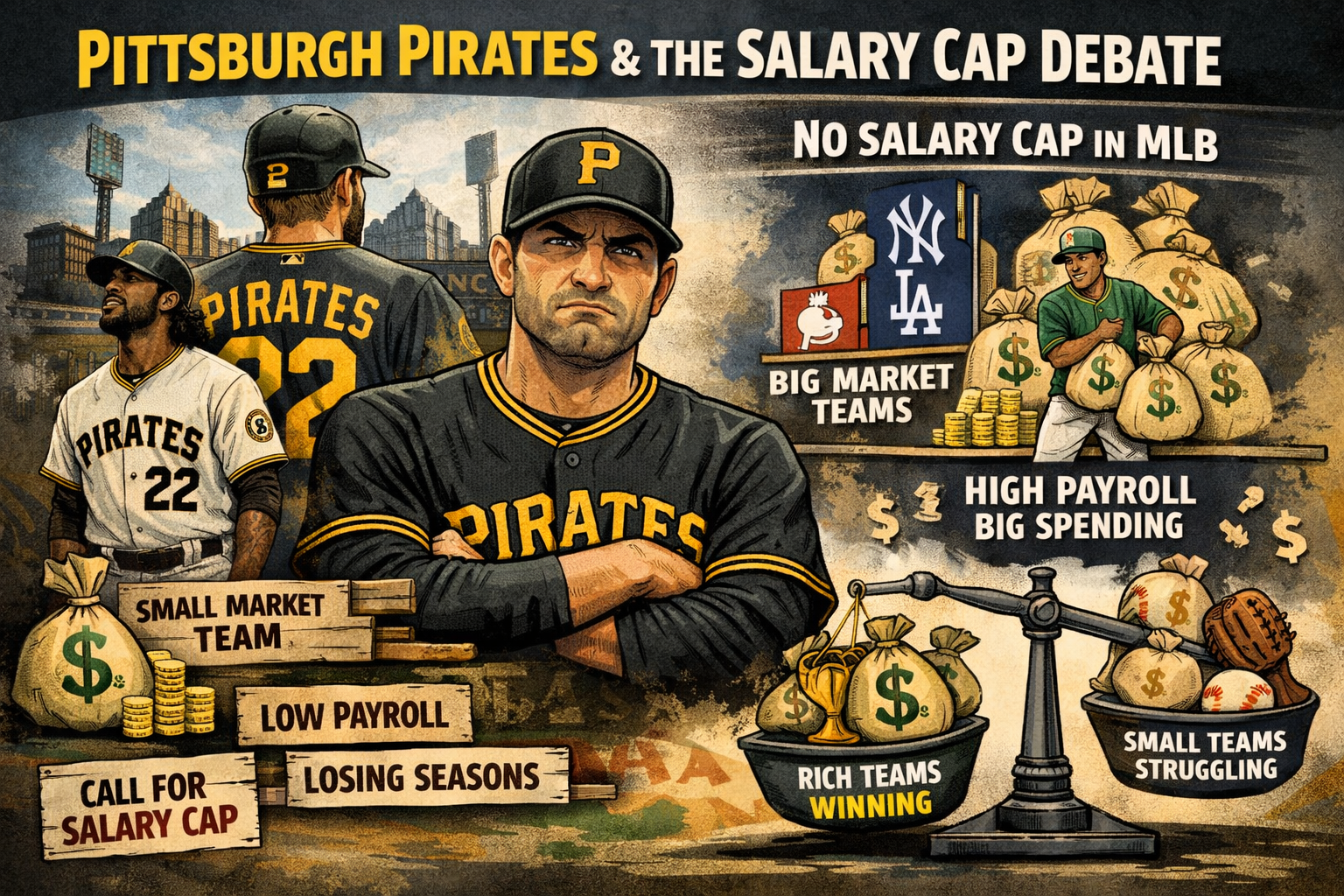
The Pittsburgh Pirates and the Salary Cap Debate

The Pittsburgh Pirates are one of Major League Baseball’s oldest franchises, with five World Series championships and a rich early history. However, over the past several decades, the team has become more closely associated with losing seasons, low payrolls, and ongoing debates about financial fairness in Major League Baseball.
A central question often raised by fans and analysts alike is whether the Pirates’ struggles are the result of MLB’s lack of a true salary cap—or whether deeper organizational and economic decisions are to blame.
A Long History of Losing
The Pirates’ modern struggles are well documented. From 1993 to 2012, the franchise endured 20 consecutive losing seasons, one of the longest such streaks in North American professional sports.
Although the team briefly returned to relevance with playoff appearances from 2013–2015, success has not been sustained. In recent years, the Pirates have frequently finished near the bottom of the standings, sometimes approaching or exceeding 100 losses in a season.
Low attendance has followed. For example, in 2025 the team averaged under 18,000 fans per game—near the bottom of MLB—highlighting the connection between performance and fan engagement.
No Salary Cap in MLB: A Structural Issue
Unlike the National Football League or National Basketball Association, MLB does not have a hard salary cap. Instead, it uses a luxury tax system, which penalizes teams that exceed a certain payroll threshold but does not prevent them from spending heavily.
This has led to massive payroll disparities across the league. Large-market teams like the New York Yankees and Los Angeles Dodgers routinely spend two to four times as much as smaller-market teams.
Historically, higher payroll teams have had more consistent success. High-spending clubs have dominated divisions and playoff appearances over long stretches, reinforcing the idea that money strongly correlates with winning in baseball.
The Pirates’ Payroll Reality
The Pirates are often cited as one of MLB’s most frugal franchises. In multiple seasons, their payroll has ranked near the bottom of the league. For example, in 2022, their payroll was roughly $47 million, among the lowest in baseball.
Even in more recent seasons, payroll figures have remained modest compared to competitors. In 2025, the team’s payroll was about $76 million, far below big-market teams that routinely exceed $200 million.
This limited spending affects the team in several ways:
- Difficulty retaining star players
- Limited participation in high-end free agency
- Reliance on prospects and short-term contracts
Notably, stars such as Andrew McCutchen and Gerrit Cole were traded or allowed to leave rather than being retained on expensive long-term deals, often to reduce payroll obligations.
Revenue Sharing: A Safety Net That Raises Questions
MLB attempts to balance inequality through revenue sharing, redistributing money from high-revenue teams to smaller-market clubs like the Pirates.
For instance:
- Pirates received tens of millions annually in revenue-sharing funds
- In one example, they received about $25 million in a single season
- League-wide distributions have reached over $100 million per team in some years
In theory, this money is meant to improve on-field performance. However, critics argue that the Pirates have not consistently reinvested these funds into player salaries.
Financial reports have even shown that the team remained profitable during losing seasons, generating tens of millions in profit while maintaining a low payroll.
Is the Lack of a Salary Cap to Blame?
At first glance, the Pirates’ struggles seem like a clear example of why MLB might need a salary cap. Without spending limits, wealthier teams can outspend smaller ones dramatically.
However, the reality is more complicated.
Arguments Supporting a Salary Cap
- Would reduce payroll disparities
- Could improve competitive balance
- Might prevent wealthier teams from stockpiling talent
Arguments Against the Salary Cap Explanation
- MLB already has revenue sharing and a luxury tax, which partially level the playing field
- The Pirates receive significant financial support but still choose low payrolls
- There is no salary floor, meaning teams are not required to spend a minimum amount
Critics argue that the Pirates’ issues are less about structural inequality and more about ownership strategy—specifically, a reluctance to invest heavily in player payroll despite having the financial ability to do so.
Profitability vs. Competitiveness
One of the most controversial aspects of the Pirates’ situation is that losing has not necessarily meant financial failure.
Reports indicate:
- The team has generated substantial revenue from MLB sources (TV deals, licensing, etc.)
- Player payroll has often been a fraction of total revenue
- The franchise has remained profitable even during extended losing periods
This dynamic creates a unique incentive structure:
Winning is not strictly necessary for financial success in MLB, particularly for small-market teams benefiting from revenue sharing.
A Broader MLB Problem
The Pirates are not alone. Other small-market teams face similar challenges, and the debate over a salary cap continues to surface during labor negotiations.
However, any implementation of a salary cap would likely require:
- A salary floor (minimum spending requirement)
- Agreement from the MLB Players Association, which has historically opposed caps
- Major changes to the league’s economic system
As of now, MLB remains the only major North American league without both a salary cap and a salary floor.
Conclusion: More Than Just a Cap Problem
The lack of a salary cap in MLB undeniably contributes to financial inequality between teams. But in the case of the Pittsburgh Pirates, the evidence suggests that the issue is not purely structural.
Despite receiving revenue-sharing funds and maintaining profitability, the franchise has consistently chosen to operate with one of the lowest payrolls in the league.
In other words, while a salary cap might help address league-wide disparities, the Pirates’ prolonged lack of success appears to be driven as much by organizational philosophy and spending choices as by the rules of the system itself.
For fans, that distinction matters—because it suggests the problem may not be impossible to fix.