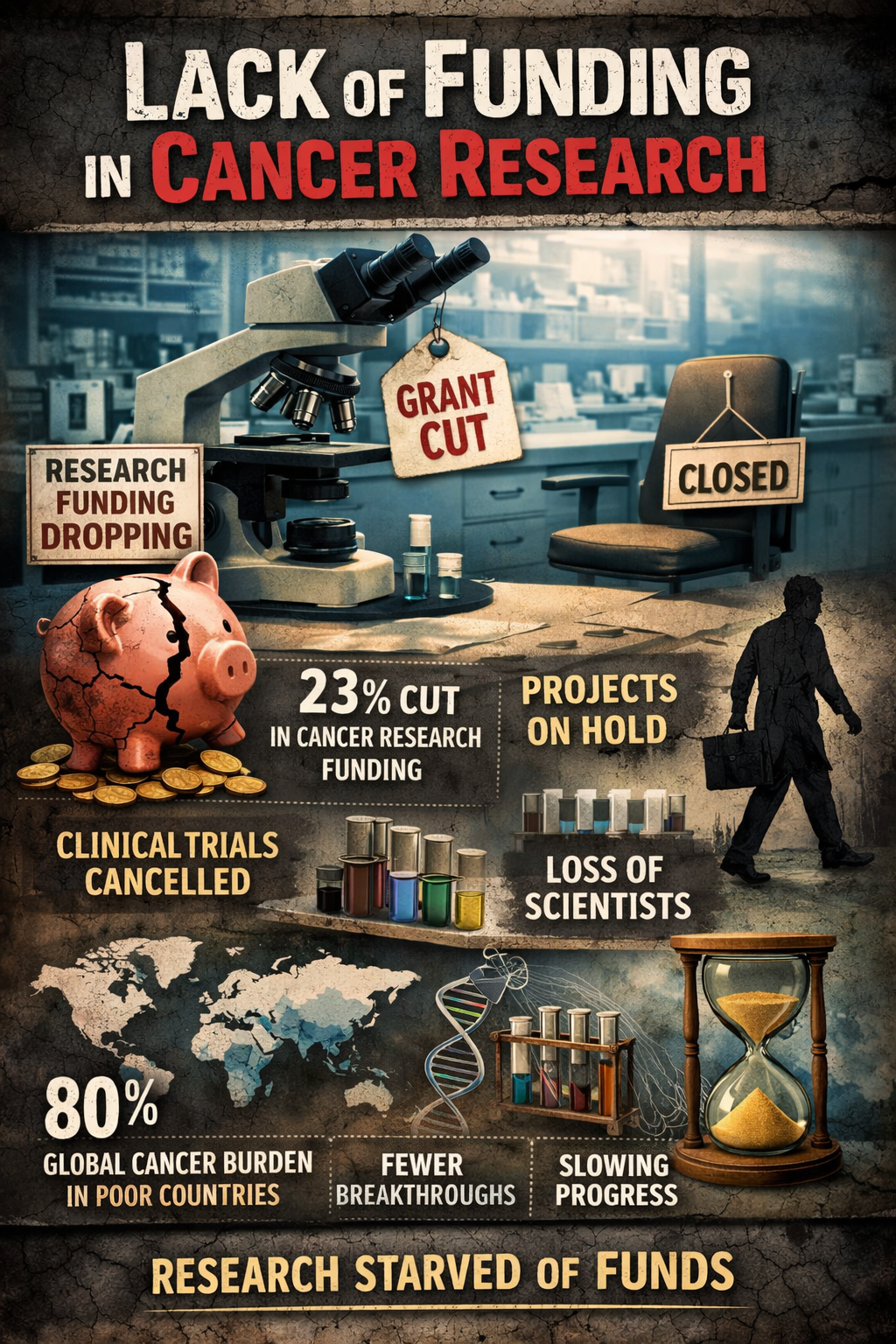
The Growing Crisis: Lack of Funding in Cancer Research

Cancer remains one of the most devastating diseases worldwide, responsible for millions of deaths each year and affecting nearly every family in some way. Despite decades of progress and billions of dollars invested, the fight against cancer is far from over. One of the most pressing challenges facing the scientific and medical community today is not a lack of ideas, talent, or technology—but a lack of consistent and sufficient funding.
The Scale of the Problem
Globally, cancer is a leading cause of death, with more than 19.3 million new cases and 10 million deaths recorded in 2020 alone (). These numbers are expected to rise significantly due to aging populations, environmental factors, and lifestyle changes.
While funding for cancer research reaches into the tens of billions of dollars, it still falls short when compared to the sheer scale of the disease. Between 2016 and 2020, global public and philanthropic investment totaled approximately $24.5 billion, yet this funding declined year over year, highlighting a troubling trend ().
Even more concerning is that funding does not always align with the actual burden of disease. Certain cancers receive disproportionate attention, while others—often those affecting poorer populations—remain underfunded.
Slowing Growth and Recent Cuts
In the United States, the largest single funder of cancer research is the National Cancer Institute (NCI). While total spending has been substantial—over $25 billion in grants between 2015 and 2024—the rate of funding growth has slowed dramatically ().
Recent developments have made the situation even more alarming. Reports indicate that:
- Cancer research funding through the National Institutes of Health (NIH) dropped by 23% in 2025 ()
- Thousands of research grants were reduced or eliminated
- Clinical trials and ongoing studies were disrupted, affecting tens of thousands of participants ()
These cuts come at a time when cancer rates are rising and scientific opportunities—such as immunotherapy, precision medicine, and genetic research—are more promising than ever.
The Hidden Costs of Underfunding
A lack of funding does not just slow progress—it has real, measurable consequences.
1. Fewer Breakthroughs
Scientific discovery depends on sustained investment. Many of today’s life-saving treatments, including targeted therapies and immunotherapies, originated from years—often decades—of research. When funding dries up, promising projects are delayed or abandoned entirely.
2. Loss of Talent
Young scientists and researchers rely heavily on grants to build their careers. When funding becomes scarce, many leave the field altogether, resulting in a “brain drain” that can take years to recover from.
3. Disrupted Clinical Trials
Clinical trials are essential for testing new treatments. Funding cuts have already led to the cancellation of hundreds of studies, directly impacting patient care and delaying access to potentially life-saving therapies ().
4. Global Inequality
Cancer disproportionately affects low- and middle-income countries, which account for around 80% of the global cancer burden. Yet these regions receive only a small fraction of research funding, limiting their ability to develop effective, localized treatments ().
Misalignment of Funding Priorities
Another major issue is how funding is distributed. A significant portion—over 70%—is allocated to early-stage or pre-clinical research, while areas like surgery, radiotherapy, and global health receive minimal investment ().
This imbalance can slow the translation of discoveries into real-world treatments. While foundational research is critical, insufficient funding for applied and clinical research creates a bottleneck in delivering solutions to patients.
The Role of Nonprofits and Private Organizations
Interestingly, a large portion of cancer research funding does not come from governments but from nonprofit organizations and philanthropic groups. In fact, more than 60% of funding organizations are not-for-profit entities ().
Organizations like the American Cancer Society and major universities contribute billions annually. However, relying heavily on charitable funding introduces instability, as donations can fluctuate with economic conditions and public interest.
A Paradox: Progress Despite Constraints
Despite funding challenges, cancer survival rates have improved significantly. In the United States, the five-year survival rate has risen to around 70%, up from 50% in the 1970s ().
This progress demonstrates the power of research investment—but it also highlights what could be achieved with stronger, more consistent funding. Many experts argue that we are on the cusp of major breakthroughs, and now is the worst possible time to slow investment.
Why Funding Still Falls Short
Several factors contribute to the ongoing funding gap:
- Political priorities: Research funding is often subject to government budget changes and policy shifts
- Rising costs: Advanced technologies, clinical trials, and regulatory requirements make research increasingly expensive
- Competition for resources: Cancer research must compete with other urgent health issues for limited funding
- Short-term thinking: Long-term research projects are harder to justify in systems focused on immediate results
The Path Forward
Addressing the lack of funding in cancer research requires a multi-faceted approach:
- Increased Government Investment
Stable, long-term funding from governments is essential to sustain progress. - Better Allocation of Resources
Funding should be aligned with disease burden and prioritize underfunded areas like global health and treatment delivery. - Public-Private Partnerships
Collaboration between governments, nonprofits, and private industry can maximize impact and efficiency. - Support for Early-Career Researchers
Investing in the next generation of scientists ensures continued innovation. - Global Collaboration
Sharing data, resources, and expertise across borders can accelerate breakthroughs and reduce duplication of effort.
Conclusion
The fight against cancer is one of humanity’s most important scientific and medical challenges. While significant progress has been made, the current level and distribution of funding are not enough to match the scale of the problem.
Underfunding cancer research is not just a financial issue—it is a human one. Every delayed study, canceled trial, or abandoned project represents lost time in a race where time costs lives.
If society is serious about defeating cancer, then consistent, equitable, and forward-thinking investment in research is not optional—it is essential.