Computer Memory Prices: A Deep Dive into Trends, Causes, and What Comes Next

Computer memory—primarily DRAM (RAM) and NAND flash (storage like SSDs)—has always been one of the most volatile segments of the technology market. But in 2025–2026, the industry has entered one of its most dramatic pricing cycles in decades, driven by artificial intelligence, supply constraints, and structural shifts in manufacturing.
This article explores the current state of memory prices, why they’ve surged, and what the future may hold.
The Current State of Memory Prices (2025–2026)
The past year has seen explosive increases in memory pricing, affecting everything from gaming PCs to enterprise data centers.
Key Data Points
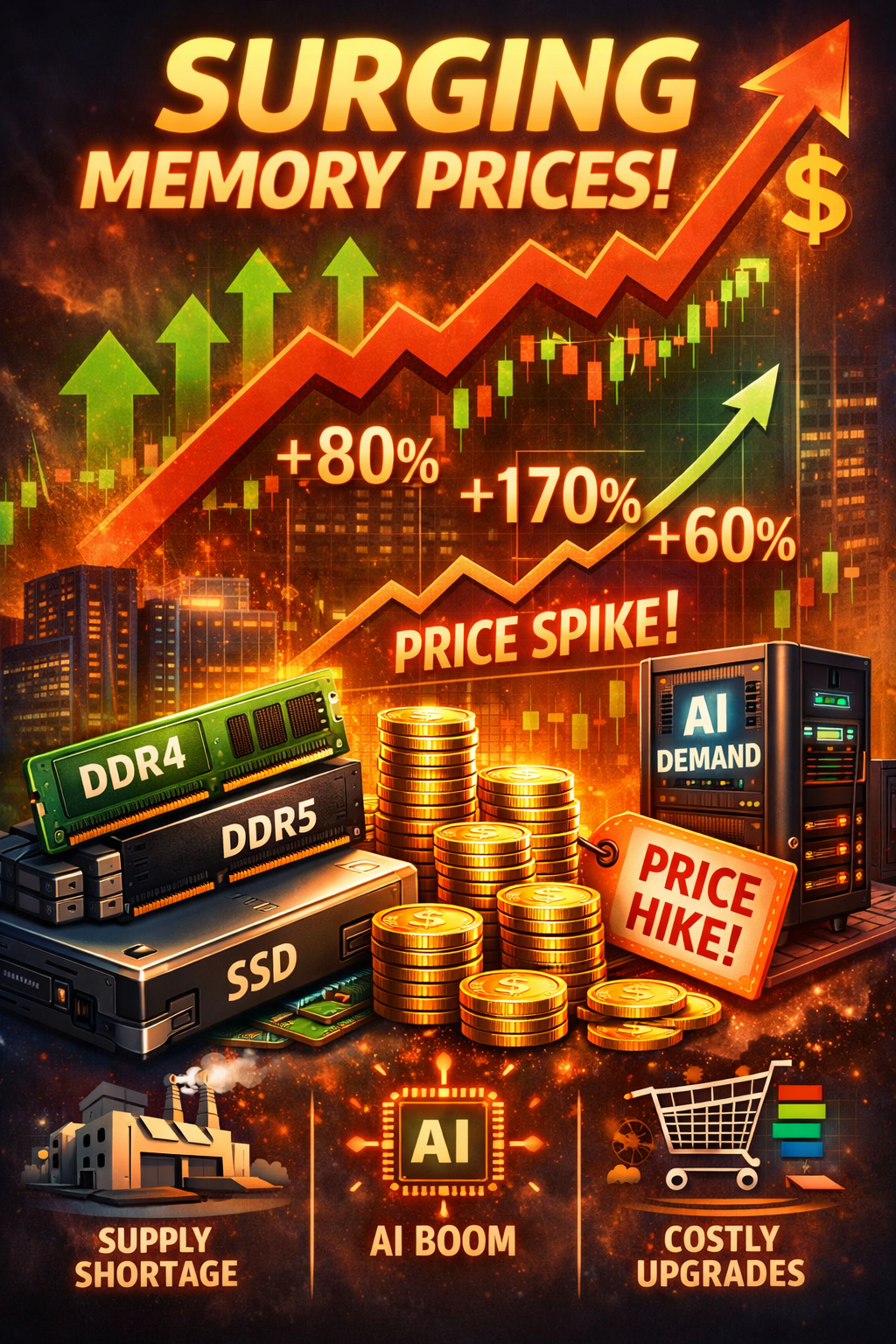
- DRAM prices increased over 170% year-over-year by late 2025
- Memory prices surged 80–90% in early 2026 alone
- NAND flash prices are rising 55–60% quarter-over-quarter
- Some DDR5 kits jumped from $100–$200 to $350+ in months
- Overall DRAM and SSD prices rose ~100% and ~40% respectively in 2025
In extreme cases, enterprise memory modules have increased from $1,000 to as high as $1,900 within a short period .
This isn’t a normal market fluctuation—it’s a structural shift.
Why Memory Prices Are Rising
1. The AI Boom Is Consuming Supply
Artificial intelligence is the single biggest driver of memory demand today.
Modern AI systems—especially large language models—require:
- Massive datasets
- High-bandwidth memory (HBM)
- Continuous real-time processing
As a result:
- Memory manufacturers prioritize data centers over consumers
- AI workloads now consume a huge share of global DRAM supply
This has created a bottleneck where consumer devices compete with billion-dollar AI infrastructure projects.
2. Supply Growth Is Slowing
Unlike CPUs or GPUs, memory production cannot scale quickly.
- DRAM supply growth in 2026: ~16%
- NAND supply growth in 2026: ~17%
These are below historical norms, signaling a constrained supply environment.
Why?
- Building fabrication plants (fabs) takes years
- Costs run into tens of billions of dollars
- Manufacturers are cautious after past boom-and-bust cycles
3. Industry Consolidation
The global memory market is dominated by just a few companies:
- Samsung
- SK Hynix
- Micron
This oligopoly means:
- Production decisions are tightly controlled
- Supply increases are deliberate—not reactive
- Pricing power is stronger than in more competitive markets
4. Shift to High-Margin Memory (HBM)
Manufacturers are focusing on high-bandwidth memory (HBM) used in AI servers because:
- It commands significantly higher profit margins
- Demand is nearly insatiable
This shift reduces:
- Availability of standard DDR4/DDR5 RAM
- Supply of consumer-grade NAND
Result: everyday users pay more
5. Spot Market Volatility and Speculation
Memory prices are increasingly unstable:
- Prices can fluctuate daily or even hourly
- Retailers raise prices rapidly during shortages
- Scalpers and bots exacerbate scarcity
This behavior mirrors past GPU shortages, creating artificial price spikes.
Impact on Consumers
1. More Expensive PCs
- Memory is now one of the most expensive components in a system
- OEMs are raising prices on laptops and desktops
2. Reduced Hardware Value
- Budget builds are becoming harder
- Entry-level systems may include less RAM or storage
3. Upgrade Dilemmas
- DDR5 offers better performance—but at a steep cost
- DDR4 is cheaper, but increasingly obsolete
4. Gaming and Enthusiast Market Resilience
Interestingly, high-end buyers are less sensitive to price increases, so:
- Gaming PCs remain strong
- Premium builds continue to grow
Impact on the Tech Industry
Data Centers
- Memory is now a primary cost driver
- AI infrastructure spending is skyrocketing
Smartphones
- Manufacturers may reduce RAM capacity to offset costs
Cloud Computing
- Higher memory costs = more expensive cloud services
Automotive & IoT
- Memory shortages are affecting embedded systems and smart devices
Are Prices Going to Keep Rising?
Short-Term Outlook (2026)
- Prices likely continue rising, but at a slower pace
- NAND may increase another 10–20% in mid-2026
- Volatility remains high due to supply constraints
Medium-Term (2027–2028)
- New fabrication plants may ease supply
- Prices could stabilize—but not return to old lows
Long-Term Trends
- Memory may remain structurally expensive
- AI demand could permanently shift pricing upward
A Fundamental Shift in Memory Economics
Historically, memory followed a predictable cycle:
Oversupply → Price crash → Undersupply → Price spike
But today, analysts describe a “structural reset” .
Why this time is different:
- AI demand is persistent, not temporary
- Supply expansion is cautious
- Technology scaling is slowing
This suggests:
👉 The era of cheap memory may be over
Final Thoughts
Computer memory prices are no longer just a technical issue—they’re a global economic story tied to AI, supply chains, and industrial strategy.
We are witnessing:
- One of the fastest price increases in memory history
- A shift toward enterprise-driven demand
- A future where memory is a premium resource
For consumers, the takeaway is simple:
- Buy when prices dip—even briefly
- Plan upgrades carefully
- Expect higher baseline costs going forward
For the industry, the message is even clearer:
Memory is no longer just a component—it’s a bottleneck shaping the future of computing itself.