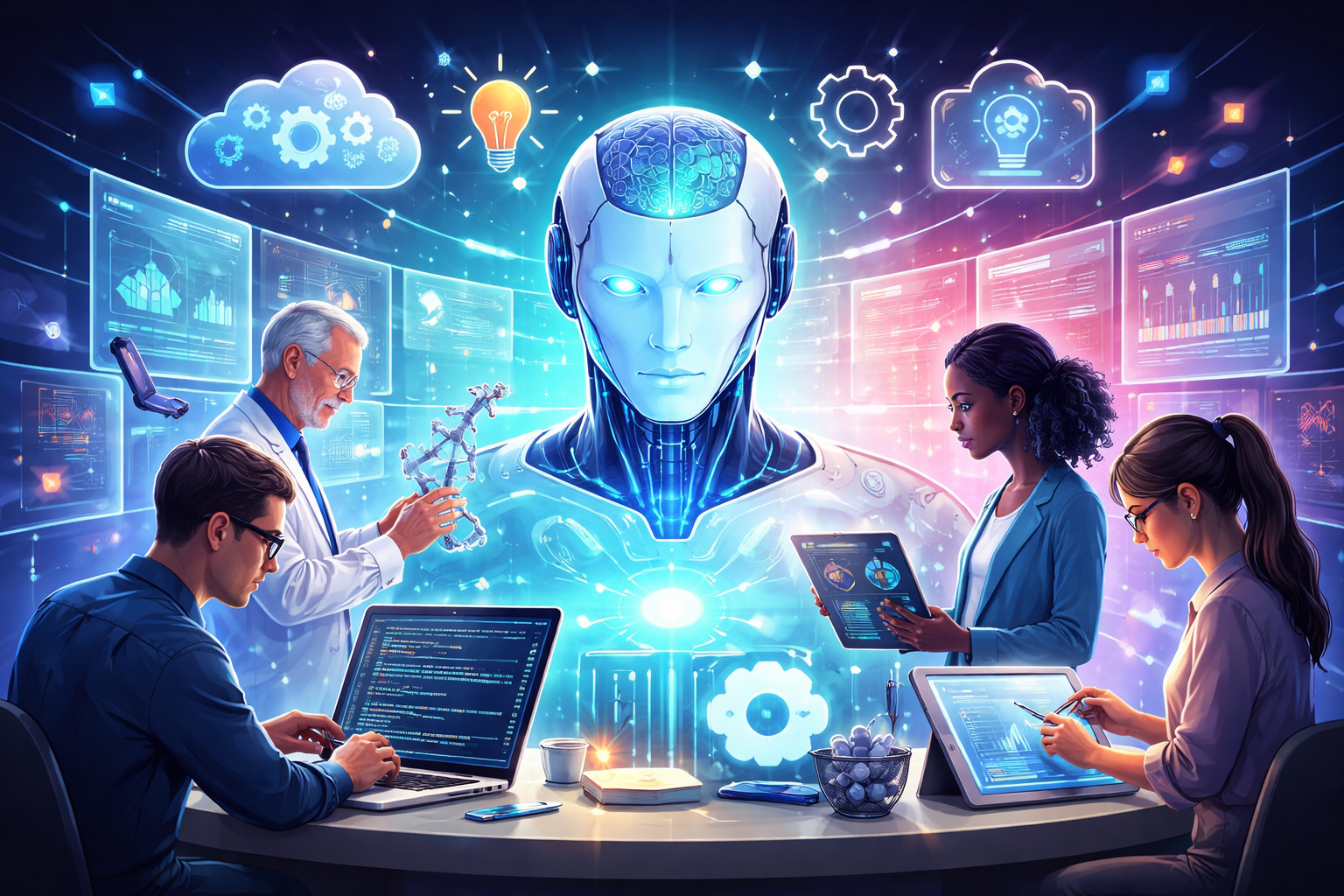
Artificial Intelligence as a Tool: Amplifying Human Capability, Not Replacing It

Artificial Intelligence (AI) is often portrayed as a looming replacement for human work and creativity. In reality, the most powerful and widespread use of AI today is far more practical—and far less dramatic. AI is best understood as a tool: a system designed to extend human ability, accelerate processes, and unlock insights that would otherwise remain hidden. Like the calculator, the internet, or the printing press before it, AI is not inherently good or bad. Its value depends entirely on how it is used.
What Is Artificial Intelligence, Really?
Artificial Intelligence refers to computer systems capable of performing tasks that typically require human intelligence. These include:
- Pattern recognition
- Language understanding
- Decision-making
- Prediction and forecasting
Modern AI is largely powered by machine learning (ML), where systems learn from data instead of following rigid, pre-programmed rules. A major breakthrough came with deep learning, which uses neural networks inspired loosely by the human brain.
Organizations like OpenAI and Google DeepMind have developed models capable of writing text, generating images, diagnosing diseases, and even assisting in scientific discovery.
AI as a Productivity Multiplier
One of the most immediate and measurable impacts of AI is productivity.
1. Speed and Automation
AI can process vast amounts of data in seconds. Tasks that once took hours—such as:
- Data entry
- Document summarization
- Code generation
- Customer support responses
can now be completed almost instantly.
For example, AI-powered tools can analyze thousands of legal documents in minutes, a task that would take a team of lawyers days or weeks.
2. Accuracy and Consistency
AI systems excel at repetitive tasks with consistent rules. In industries like manufacturing, AI-driven quality control systems can detect microscopic defects more reliably than human inspectors.
3. Decision Support
AI does not just automate—it augments decision-making. In finance, algorithms analyze market trends and risk factors. In healthcare, AI models assist doctors by flagging anomalies in medical scans.
AI in Key Industries
Healthcare
AI is transforming medicine in several ways:
- Detecting diseases such as cancer earlier through imaging analysis
- Predicting patient outcomes using historical data
- Accelerating drug discovery by simulating molecular interactions
A study published in Nature found that AI systems can match or exceed human radiologists in certain diagnostic tasks.
Business and Finance
Companies use AI for:
- Fraud detection (analyzing unusual transaction patterns)
- Customer behavior prediction
- Supply chain optimization
High-frequency trading firms rely on AI to make split-second investment decisions.
Education
AI tools are enabling personalized learning:
- Adaptive platforms adjust difficulty based on student performance
- AI tutors provide instant feedback
- Automated grading reduces teacher workload
Software Development
AI-assisted coding tools can:
- Generate boilerplate code
- Detect bugs
- Suggest optimizations
This allows developers to focus more on architecture and problem-solving rather than repetitive tasks.
AI and Creativity
Contrary to early fears, AI is not eliminating creativity—it is reshaping it.
AI tools can now:
- Generate artwork and illustrations
- Compose music
- Write drafts of articles and scripts
Rather than replacing creators, these tools act as collaborators. A designer might use AI to generate concepts, then refine them. A writer might use AI for research or outlining, then apply human judgment and voice.
The result is often faster iteration and broader exploration of ideas.
The Data Behind AI
AI systems depend heavily on data. The more high-quality data available, the better the system performs.
Key facts:
- Modern AI models are trained on datasets containing billions (or trillions) of data points
- Training large models can require thousands of GPUs and significant energy resources
- Data quality matters more than quantity—biased or flawed data leads to biased outputs
This is why data governance and ethical sourcing are critical components of responsible AI use.
Limitations of AI
Despite its power, AI has clear limitations:
1. Lack of True Understanding
AI does not “understand” in a human sense. It identifies patterns but lacks:
- Consciousness
- Intent
- Genuine reasoning
2. Bias and Fairness Issues
AI systems can inherit biases present in their training data, leading to:
- Discriminatory outcomes
- Skewed predictions
3. Overreliance Risks
Blind trust in AI can lead to errors, especially in high-stakes areas like medicine or law. Human oversight remains essential.
Ethical Considerations
As AI becomes more integrated into society, ethical concerns grow:
- Privacy: AI systems often rely on personal data
- Accountability: Who is responsible for AI decisions?
- Job displacement: Automation may replace certain roles
However, history suggests that while technology eliminates some jobs, it also creates new ones—often requiring new skills.
AI as a Tool, Not a Replacement
The most important perspective is this: AI is not a substitute for human intelligence—it is an amplifier.
- It enhances human efficiency
- It expands creative possibilities
- It supports better decision-making
But it still requires:
- Human judgment
- Ethical oversight
- Contextual understanding
Just as a hammer does not build a house without a builder, AI does not create value without human direction.
The Future of AI Tools
Looking ahead, AI will likely become:
- More integrated into everyday software
- More personalized to individual users
- More capable of handling complex, multi-step tasks
We are moving toward a world where AI is embedded in nearly every profession—not as a replacement, but as a standard tool of the trade.
Final Thought
Artificial Intelligence is one of the most powerful tools humanity has ever created. Its impact will not be defined by the technology itself, but by how we choose to use it.
Used wisely, AI can help solve some of the world’s biggest problems—from disease to climate modeling to education gaps. Used carelessly, it can amplify existing inequalities.
The difference lies not in the machine—but in the human behind it.